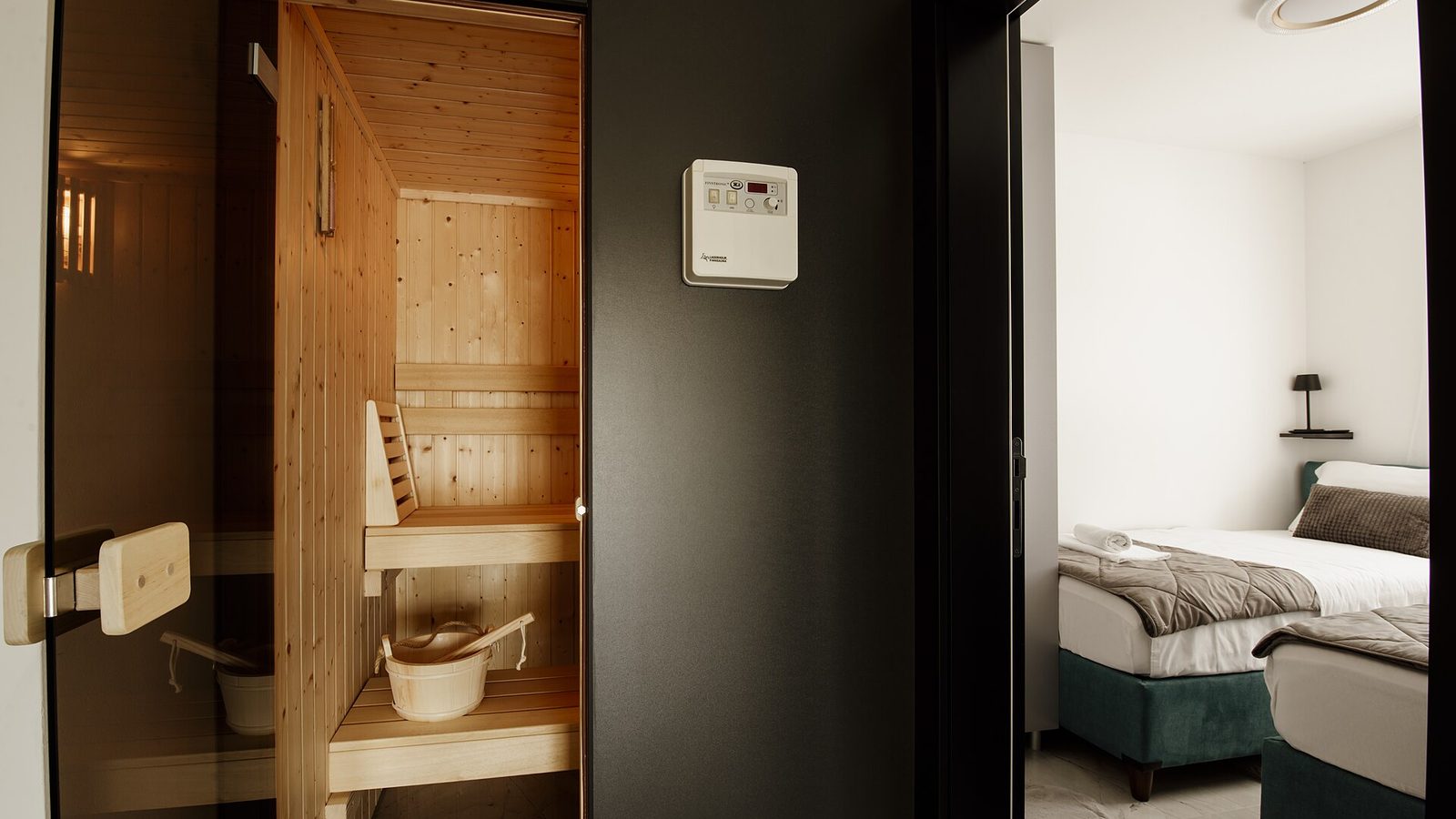
Both are wooden rooms that make you hot. They get there differently, and that difference decides the temperature, the wiring and where the sauna can live.
How the heat reaches you
A traditional sauna heats the air. An electric heater warms a load of stones and the room around them to somewhere between 160 °F and the 194 °F the residential code caps it at. Ladle water onto the stones and a burst of steam raises the humidity, which makes the same air temperature feel much hotter.
An infrared cabinet heats you more than the air. Carbon panels on the walls radiate heat that warms skin and surfaces directly, while the air usually sits at 120 to 140 °F. Sun Home and Sunlighten list their halogen full-spectrum cabins at up to 165 and 170 °F. Golden Designs, which makes the Dynamic and Maxxus cabinets, gives 118 to 132 °F as the usual range. There are no stones, so there is no steam.
Side by side
| Infrared cabinet | Traditional sauna | |
|---|---|---|
| Air temperature | Usually 120–140 °F; up to 170 °F in some full-spectrum cabins | 160–194 °F |
| Steam | None | Water on the stones |
| Warm-up | About 20 min to 100 °F, 45–60 min to 135 °F (Golden Designs manual) | Depends on kilowatts, room size and stone mass |
| Power | 1.7–2.4 kW on a 120 V outlet, 15 or 20 A | 4.5–9 kW on 240 V, hard-wired, 25–45 A |
| Installation | Panels that latch together on a level floor | A built room or a kit, with the heater wired by an electrician |
| Size | 1 to 3 people in 3 to 5 feet of wall | Set by the room; heaters cover 100 to 500 cubic feet |
Power is usually the deciding factor
A one- or two-person infrared cabinet plugs into a 120 V outlet, often an existing one. The Dynamic Barcelona, for example, runs on 15 A. Three-person cabinets and most full-spectrum cabins from Sunlighten, Sun Home and Clearlight want a 20 A circuit to themselves, which is a new run but a simple one.
A traditional heater needs a 240 V circuit on its own 2-pole breaker, wired straight to the heater with no plug. A 6 kW heater draws 25 A, and Harvia and HUUM both call for 10-gauge copper rated 90 °C. If the panel has no room for another 2-pole breaker, or the service is near its limit, that work comes first. The electrical page has the full table.
Space and permanence
An infrared cabinet is a piece of furniture. It arrives as panels, sits on any level floor and goes with you when you move. The smallest, the Dynamic 1-person compact, is 36 by 28 inches.
A traditional sauna is a room. Indoors that means framing, insulation, a vapor barrier and wood lining, built to the heater’s clearances and a ceiling of at least 75 inches for a Harvia KIP. Outdoors it is a barrel or cabin kit on a foundation, covered on the outdoor page. Either way the heater falls under the residential code’s sauna section: installed to the maker’s instructions, listed to UL 875, with a guard around it and a thermostat that stops at 194 °F.
Which way to lean
If the space is a spare room or a corner, and running 240 V would mean a panel upgrade, an infrared cabinet is the practical fit. If you want steam and air hot enough to feel it on the top bench, only a stone heater does that, and the room and circuit are part of the project. The sizing calculator gives the heater size and current for a room, and the running cost guide puts a number on each session.